
Find the capability that turns a charging problem into evidence.
Start with the blocked engineering decision—not a product name. The EVCA Capability Hub connects six distinct test mechanisms with the systems, standards and releases that support them, then routes the result into the right hardware, licences and Test Libraries.
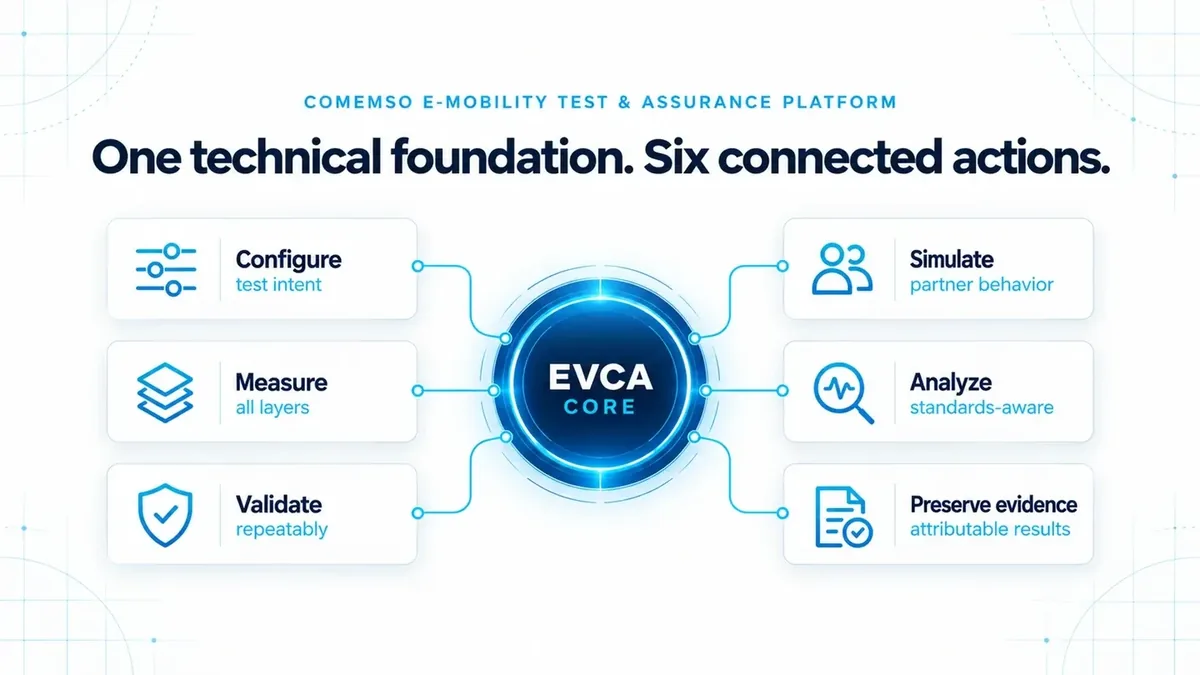
Capabilities answer a different question from products
Applications describe the customer problem. EVCA capabilities define the engineering mechanism. EVCA systems define the physical interface, mobility and power depth. comframe and related software functions manage configuration, data, reports and integration.
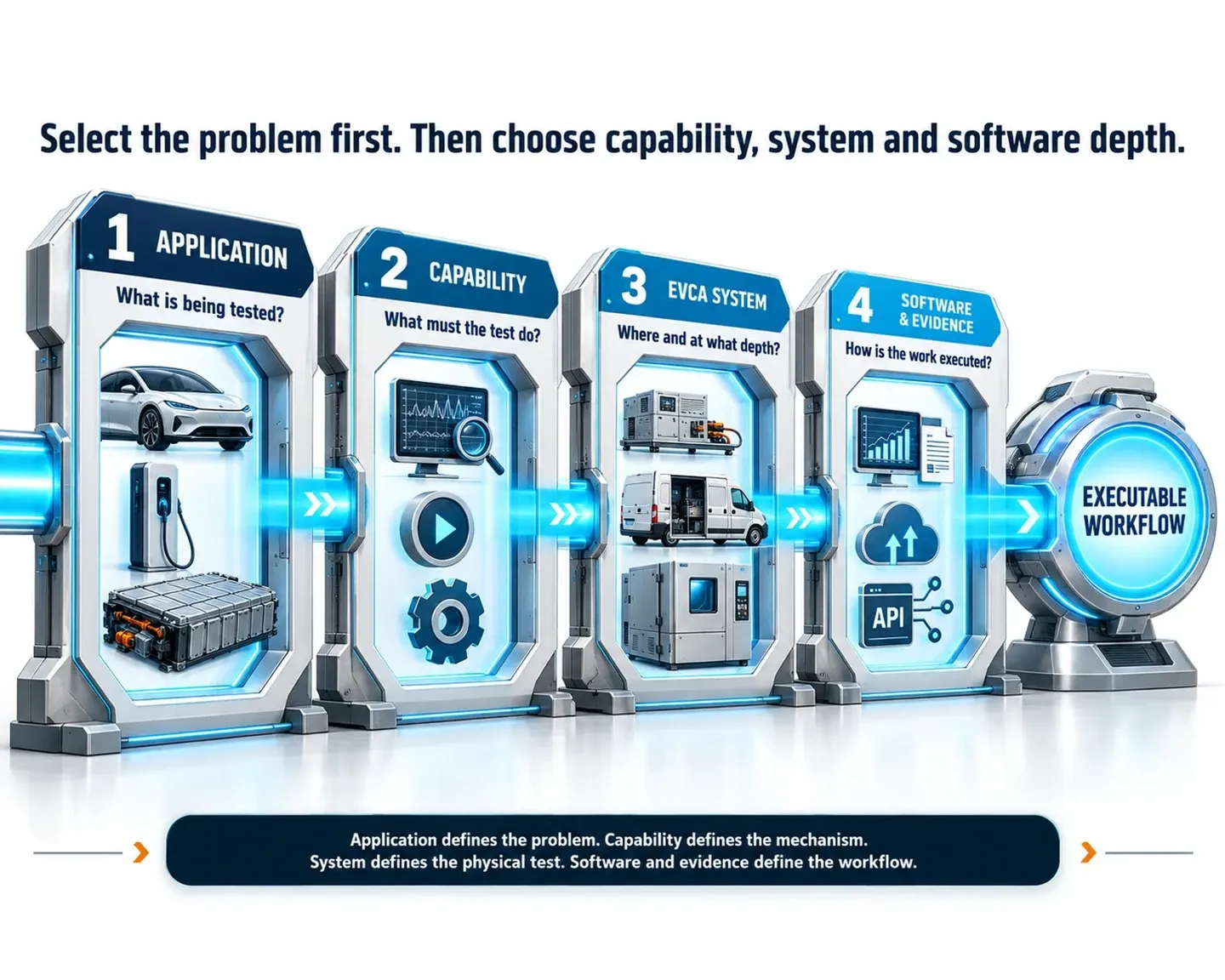
Six EV charging test capabilities. Six different engineering questions.
Use the filter to focus on the outcome required now. The individual detail pages explain the mechanism, release limits, compatible workflows and configuration inputs.
Showing all six capabilities.
Automated Standards Analysis
I have decoded data. Does the measured session follow the expected timing, states and limits?
Connect measurements, messages and signal states with normative expectations so deviations become visible without manual cross-checking.
Explore capabilityProfessional Simulation
How does the DUT (device under test) react when the simulated charging partner sends borderline or non-conform behaviour?
Configure HLC (high-level communication) content, optional messages, delays, timeouts and unexpected sequences without first developing a new charging test programme.
Explore capabilityCharge Playback
Can the real field partner be brought back into the laboratory as an active, repeatable simulation?
Turn recorded EV or EVSE (electric vehicle supply equipment, or charging station) protocol behaviour into a reusable charging partner at the physical interface. This is active playback, not offline trace replay.
Explore capabilityManipulating Gateway
Will a selected message, value or timing change alter the result while the real EV and EVSE remain connected?
Test a technical correction hypothesis live between both real charging partners before implementing software changes in either product.
Explore capabilityCharge Cycle Automation
How can complete charging configurations become repeatable campaigns for regression and unattended laboratory use?
Sequence saved behaviours, repetitions and complete charging cycles while keeping measurements and reports attributable to the active configuration.
Explore capabilityConformance Test Libraries
Which ready-to-run test cases cover the required standard, edition, DUT role and released scope?
Use implemented, versioned and supported test logic with controlled execution, structured verdicts, reports and lifecycle support.
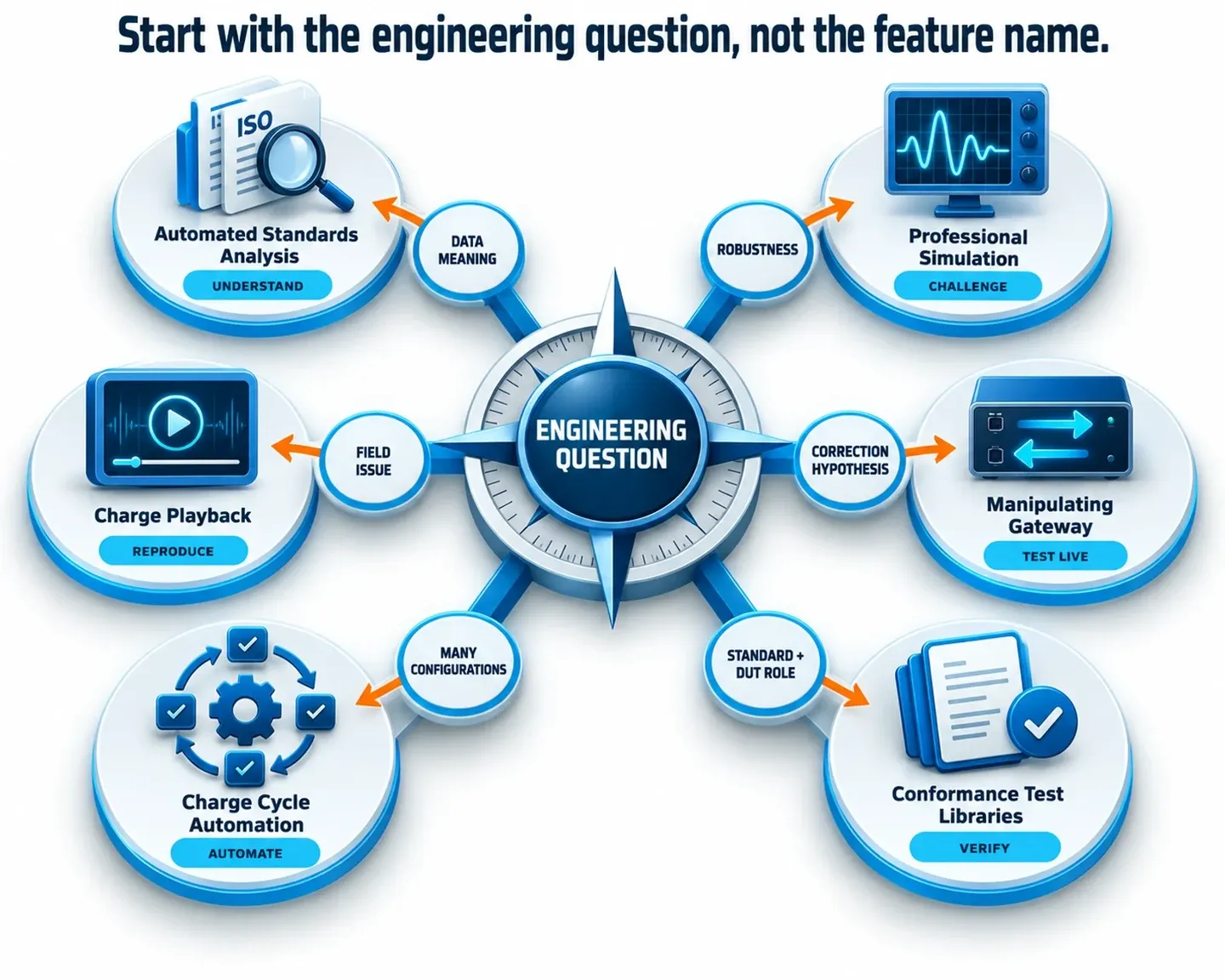
Explore capabilityStart with the problem that blocks the next decision
Choose the engineering question you need to answer, then explore the capability that supports it.
EV charging test intelligence becomes stronger when capabilities work together
A single capability can solve a focused task. Complex root-cause and release decisions often combine several mechanisms while keeping one measurements linked to their test conditions chain.
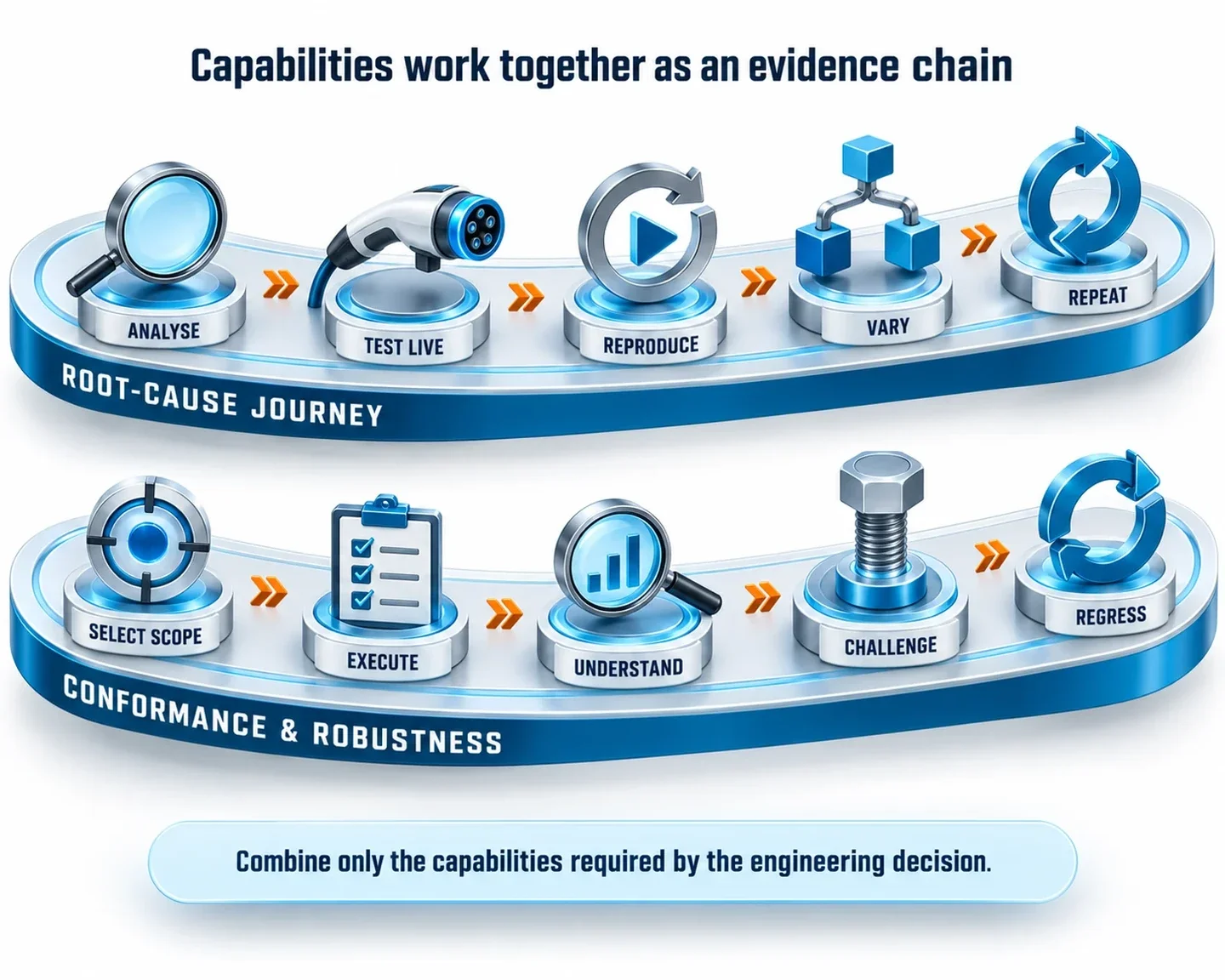
From deviation to verified correction
Use charging analysis to locate the first meaningful deviation. Test a live hypothesis, reproduce the recorded partner, create controlled variants and repeat the case after the correction.
From standard scope to understandable verdict
Run released test cases, connect each verdict to traces and measurements, challenge additional robustness boundaries and preserve the same campaign after DUT changes.
Open when required, ready when possible
EV charging test automation can use REST API, Python or CI/CD integration to extend a released workflow. These interfaces support the charging-specific test logic instead of replacing it.
Showing decoded data is not the same as analysing it. Configure the test. Do not develop the test environment.
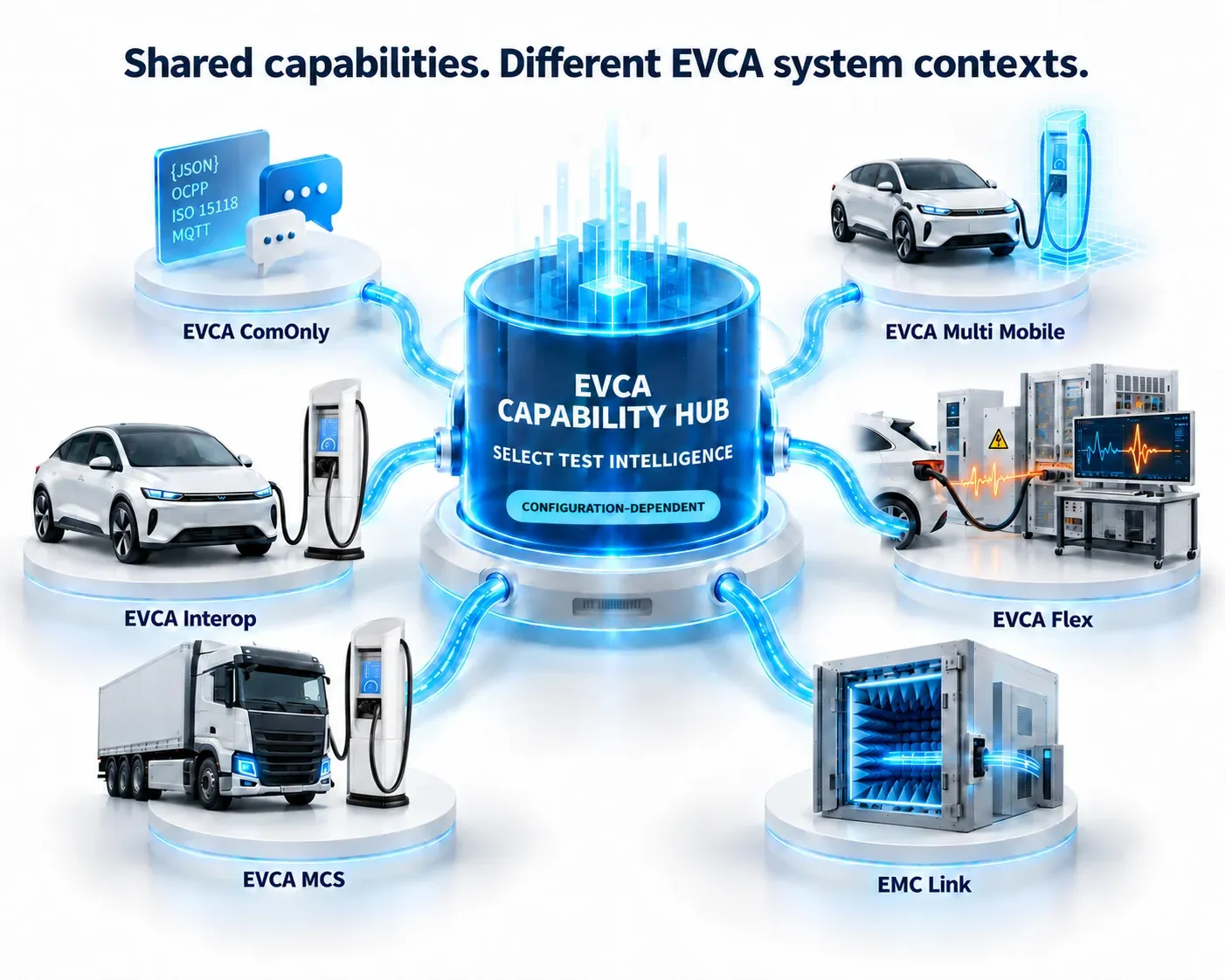
Map the required test intelligence to the EVCA system context
The same capability can appear in more than one system. The table indicates typical relationships, not released compatibility. The quotation and current release matrix remain authoritative.
On smaller screens, scroll the table horizontally to see every column.
| Capability | ComOnly | Multi Mobile | Interop | Flex | MCS | EMC Link |
|---|---|---|---|---|---|---|
| Automated Standards Analysis | Primary fit | Primary fit | Primary fit | Primary fit | Release-specific | Via connected EVCA |
| Professional Simulation | Primary fit | Common option | Common option | Primary fit | Release-specific | Via connected EVCA |
| Charge Playback | Published option | Primary fit | Primary fit | Common option | Release-specific | Via connected EVCA |
| Manipulating Gateway | Project-specific | Primary fit | Primary fit | Common option | Release-specific | Via connected EVCA |
| Charge Cycle Automation | Common option | Common option | Common option | Primary fit | Release-specific | Via connected EVCA |
| Conformance Test Libraries | Primary fit | Common option | Supporting role | Primary fit | Release-specific | Via connected EVCA |
Use EVCA capabilities across development, interoperability and release decisions
Combine charging protocol analysis, physical measurement, robustness testing, automation and conformance testing to meet your application requirements. Confirm the released scope for each capability.
Challenge the communication controller directly
Combine nominal simulation, non-conform behaviour, timing analysis, test cases and regression before the complete vehicle or charger exists.
Connect charging behaviour with vehicle reactions
Use simulation, standards-aware evaluation, field-derived partners and repeatable campaigns as the vehicle programme matures.
Test the charger from protocol to power context
Run controlled EV behaviour, conformance workflows, robustness variants and attributable regression across software versions.
Turn one failed pair into a controlled case
Analyse the real interaction, test a live hypothesis, reproduce the partner and preserve the case for later regression.
Deliver repeatable scope and understandable evidence
Connect versioned Test Libraries and verdicts with traces, timing, signals, reports and release governance.
Keep the test basis stable while the DUT changes
Reuse saved configurations and evidence structures after every build, parameter set, hardware revision or corrective action.
EVCA capabilities at a glance
- Six named EVCA capabilities solve different engineering questions.
- Several capabilities can form one evidence workflow.
- Capability selection precedes system and project configuration.
- Explore each capability for its operating principle and release limits.
What requires release approval
- Protocol, standard edition, DUT role and direction.
- Supported systems, hardware modules and operating modes.
- Licences, Test Libraries, TLS and certificate conditions.
- Automation, API, reporting and unattended-operation scope.
Configure the capability stack around the engineering decision
An EVCA capability name is not a complete test specification. Define the DUT, protocol and evidence first, then qualify the system, release and integration path.
EVCA Capability Hub FAQ
What is the EVCA Capability Hub?
The EVCA Capability Hub is the selection layer for the shared test intelligence used across the EVCA portfolio. It explains what the test must do, such as analyse, challenge, reproduce, manipulate, automate or verify, before the user selects the final EVCA system and project configuration.
What is the difference between an EVCA capability and an EVCA system?
A capability describes the test mechanism or engineering outcome. An EVCA system describes the hardware, interfaces, mobility and power depth used to apply it. One capability can appear in several systems, while one system can combine several capabilities.
Are all EVCA capabilities available on every EVCA system?
No. Availability depends on the charging protocol, standard edition, DUT role, hardware modules, software release, licences, security conditions and selected Test Libraries. The system-fit matrix is a routing aid, not a compatibility guarantee.
Which capability analyses a charging session against standards?
Automated Standards Analysis connects measured timing, messages, signal states and relevant electrical values with normative expectations. It highlights deviations in context instead of only displaying decoded data.
Which capability creates non-conform charging behaviour?
Professional Simulation configures the simulated charging partner. Where released, it can change supported HLC values, optional messages, timing, timeouts and unexpected sequences for robustness testing without requiring the core test to be programmed from scratch.
What is the difference between Professional Simulation and Manipulating Gateway?
Professional Simulation controls a simulated EV or EVSE charging partner. Manipulating Gateway operates between a real EV and a real EVSE and changes selected live communication to test a specific engineering hypothesis.
Capability scope
Define how this capability should support the test.
Specify the DUT, released configuration, controlled method and engineering result.