
Standards & Knowledge / Charging, Field Safety & EMC
Understand the Standards behind EV Charging Tests
Separate four questions: Is the electrical behaviour correct, do the devices communicate, is the installation suitable, and does the system tolerate electromagnetic disturbances? Then find the standards relevant to your test.
Start with the engineering responsibility
A standard number alone
does not define the test.
The same document family can apply to different devices, interfaces and decisions. Fix the DUT (device under test) role and test objective before selecting hardware, software or an executable Test Library.
EV and EVCC
Validate vehicle-side charging behaviour, onboard communication, low-level states, timing, power coordination and release readiness.
Open EV testingEVSE and SECC
Validate charging-station behaviour, safety reactions, communication, DC power control, production evidence and field operation.
Open EVSE testingReal EV plus real EVSE
Investigate interoperability by correlating both implementations on one synchronised time base instead of testing either side in isolation.
Open interoperability analysisLaboratory, production or field
Use the same the applicable standard requirements differently for development analysis, conformance, end-of-line testing, commissioning, inspection and service.
Configure the test routeGlobal charging standards landscape
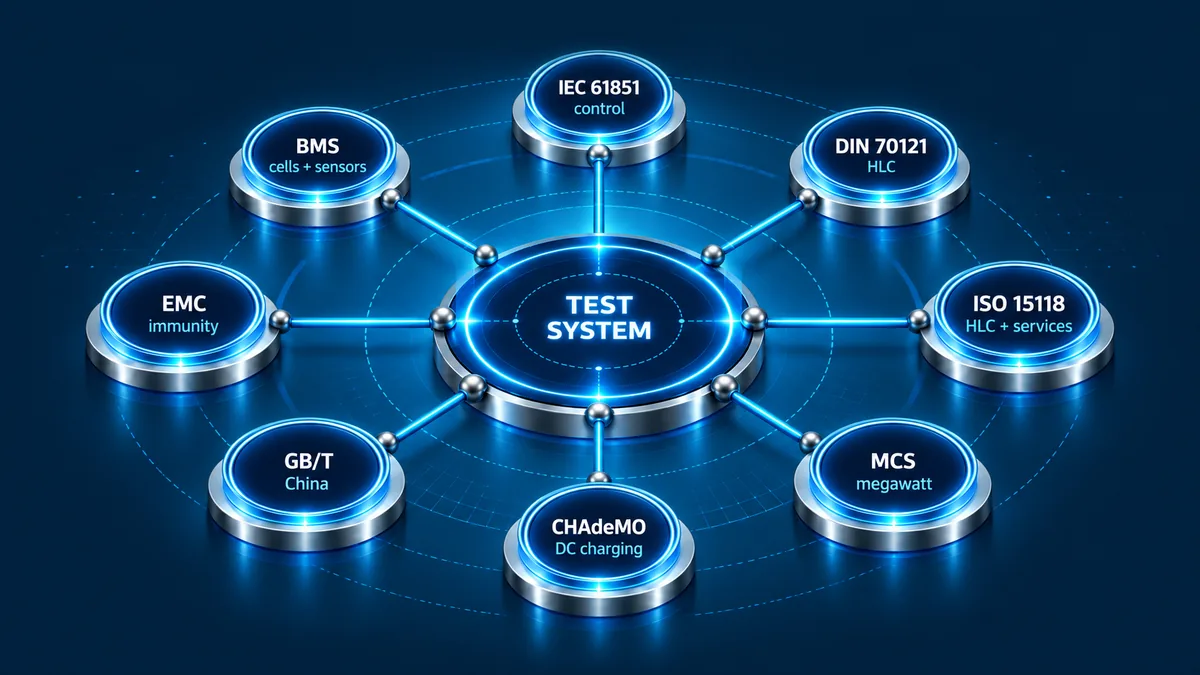
Six standards routes cover different charging technologies and technical layers.
The routes below provide engineering orientation. Exact product support depends on the configured interface, DUT role, protocol edition, software release, licence and approved quotation.
IEC 61851
General conductive charging requirements, basic signalling, DC EV supply equipment and digital control of DC charging.
EVSE test routeDIN 70121 and ISO 15118
High-level communication between EVCC (vehicle-side charging communication controller) and SECC (station-side charging communication controller), including discovery, sessions, services, security and charging control by generation and profile.
EVCA platformSAE and NACS
North American coupler, control-pilot and charging-system context. State the exact SAE document revision, connector and communication profile.
Qualify the configurationCHAdeMO
Technology-specific DC charging communication, state handling and interoperability. Public comemso portfolio information lists versions from 0.9.1 through 2.0.
See EVCA system pathsGB/T
Chinese DC charging control and communication context. Public comemso portfolio information includes GB/T 18487.1 and GB/T 27930 routes.
See EVCA system pathsMCS
Megawatt charging combines dedicated EVSE (electric vehicle supply equipment, or charging station) requirements, high-level communication, 10BASE-T1S, low-level states, cooling and high-power coordination.
Open EVCA MCSEVSE commissioning, periodic inspection and service
“It charges” answers a compatibility question.
It does not complete the safety inspection.
A production vehicle can show that one EV and one EVSE complete one charging session. It does not create defined electrical-safety measurements, reproducible fault conditions or a complete inspection record for the installed charging station.
Useful final compatibility signal
Keep the real vehicle in the process where an actual customer pairing matters. Read the result within its boundary.
- One vehicle implementation and state
- One charging configuration and session
- No defined protective-measure inspection by itself
- No reproducible safety-fault simulation by itself
Function, protective measures and evidence
Use a defined EV simulator and the appropriate measuring functions to examine the installed EVSE before commissioning, at planned intervals and after modification, repair or a reported fault.
- Visual inspection and functional test
- Electrical-safety measurements in the defined setup
- Controlled charging and configured fault scenarios
- Structured, reviewable test results
Installation and operational safety context
- VDE 0100: installation of low-voltage electrical systems
- VDE 0105: operation of electrical installations
- DGUV Vorschrift 3: testing of electrical installations and equipment
- IEC 61851: conductive charging-system requirements
- VDE 0620 context: plugs, socket-outlets and related interfaces
Installation, interface and protection context
- IEC 60364: low-voltage electrical installations
- IEC 62196: EV plugs, socket-outlets, connectors and inlets
- NEC and CEC: United States and Canadian installation context
- UL 2202: EV charging-system equipment safety context
- UL 2231: personnel-protection systems for EV supply circuits
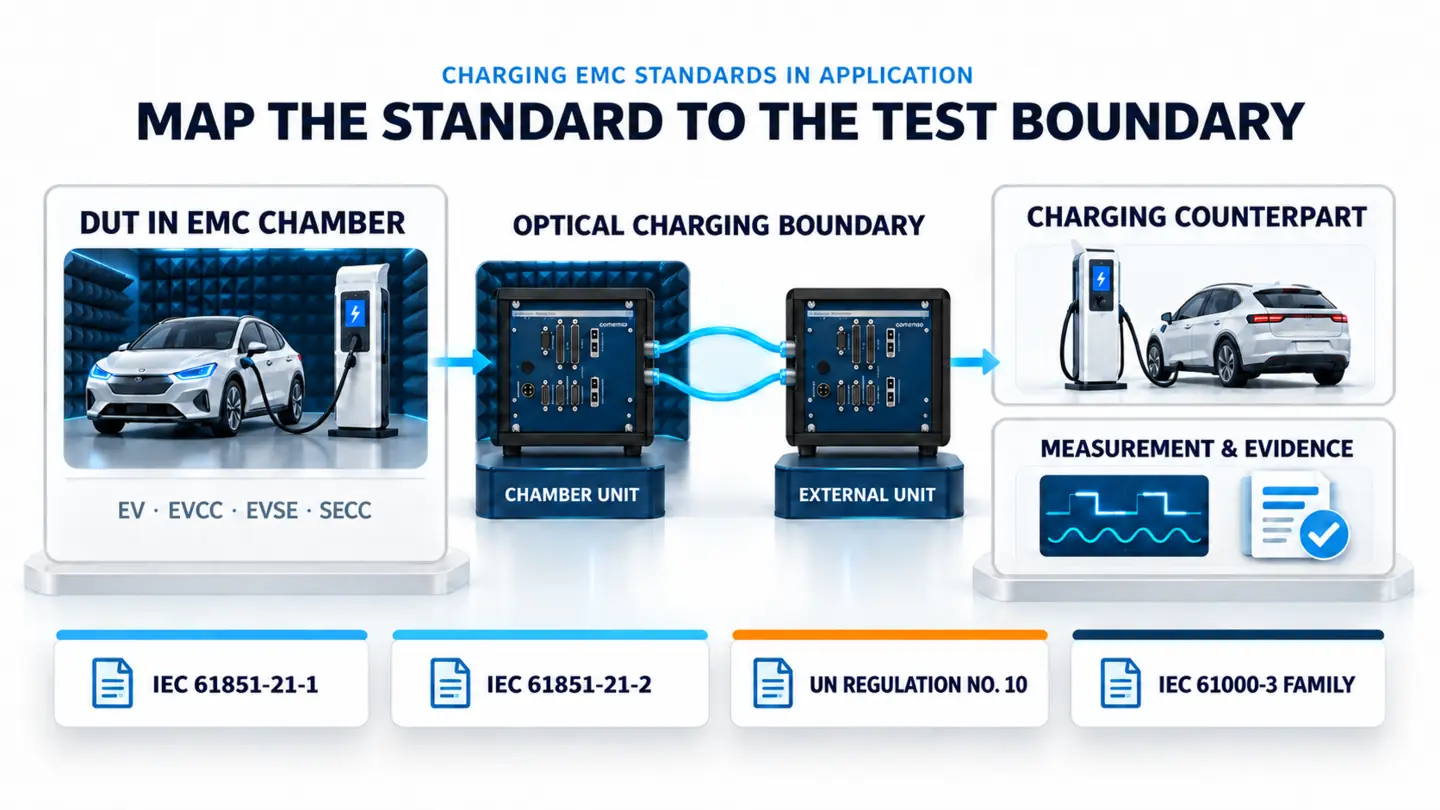
Charging EMC is a separate test axis
Map the EMC document to the DUT and chamber boundary.
Charging standards define behaviour at the charging interface. EMC standards define immunity, emissions, setup and operating conditions. A complete method must state which device is inside the chamber, which charging counterpart remains active and which evidence is recorded.
One family. Several physical and software layers.
ONE STANDARD FAMILY. SEVERAL TECHNICAL LAYERS.
with the technical boundary.
Map every claim to the actual layer and DUT role before selecting a product or Test Library.
Do not treat a communication trace, a control-pilot measurement, a power measurement and a conformance verdict as interchangeable. Each answers a different question.
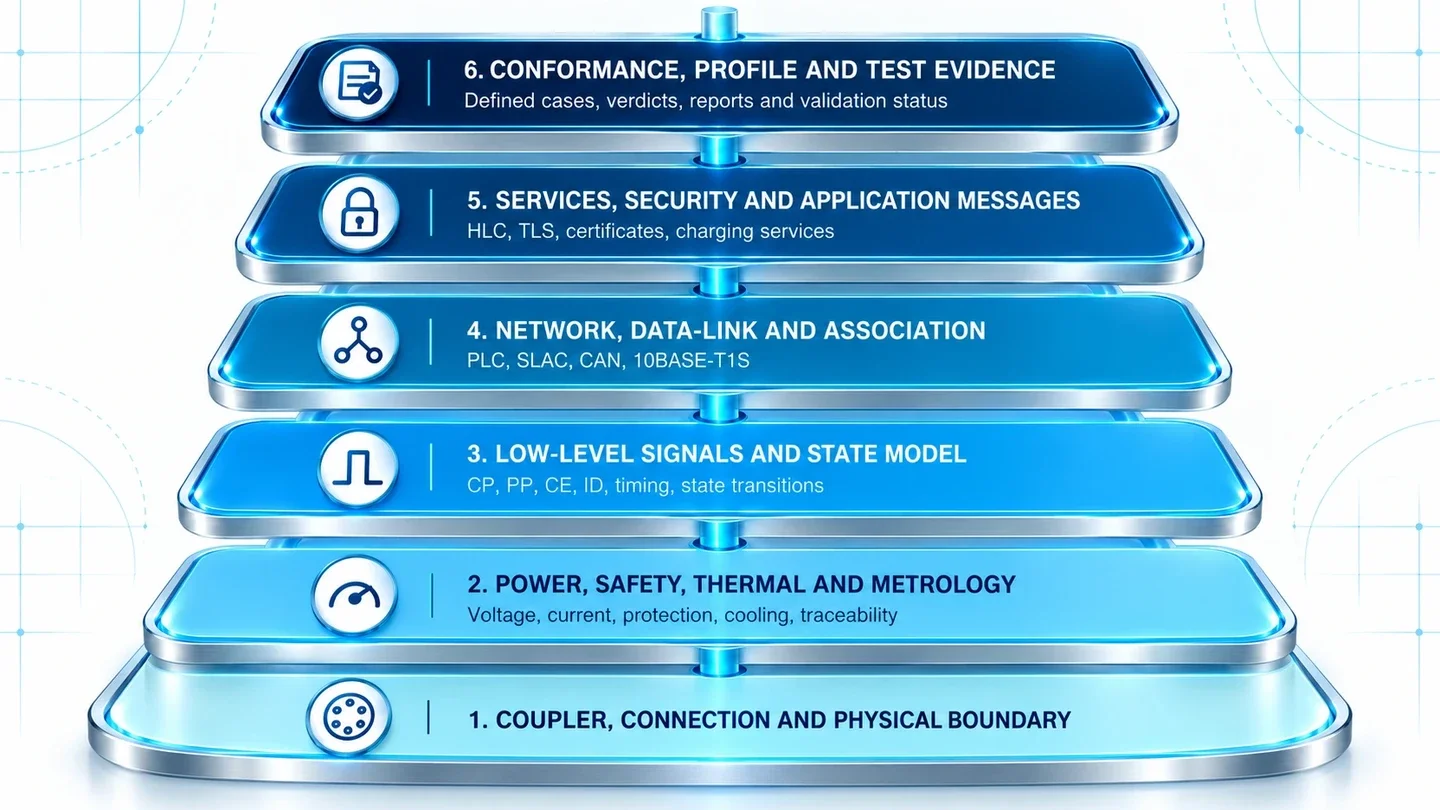
Physical boundary
Coupler, inlet, connector, cable and contact state.
Power and safety
Voltage, current, insulation, protection, thermal behaviour and metrology.
Signals and states
Control Pilot (CP), Proximity Pilot (PP), PWM, state transitions, timing and technology-specific low-level signals.
Network and data link
PLC (power line communication), SLAC, CAN, 10BASE-T1S and association behaviour.
Messages and services
Charging sequences, parameters, security, certificates and services.
Verdict and evidence
Defined cases, expectations, automated evaluation, reports and release status.
Three status questions. Never merge them.
Published standard, supported product and released Test Library are separate facts.
A newly published document changes the standards landscape. It does not automatically create hardware support, a software licence or an executable conformance library.
Standard status
Is the document published, amended, replaced, withdrawn or still under development?
Product support
Which hardware, connector, role, software release and licence support the required function?
Test Library status
Which cases, directions, preconditions, verdict logic and reports are released?
THREE STATUS QUESTIONS. NEVER MERGE THEM.
STANDARD STATUS
Is the document published, amended, superseded or draft?
Standards organisation
PRODUCT SUPPORT
Which hardware, interface, licence and release support it?
Approved product matrix
LIBRARY STATUS
Which cases, direction, scope and implementation are released?
Test Library matrix
A published standard does not automatically create product support or an executable Test Library.
Current document changes to qualify
Recent publications change the map. Release support still requires separate confirmation.
Document status below was checked against the responsible standards organisations on 4 September 2026. The official source remains authoritative.
IEC 61851-23 and IEC 61851-24
The 2023 editions update the DC EV supply-equipment requirements and the associated digital communication context for control of DC charging.
ISO 15118-20 Amendment 1
The published amendment adds AC DER service, MCS service and an improved security concept to the second-generation communication context.
IEC 61851-23-3 for MCS
The first edition defines MCS EV supply-equipment requirements and references ISO 15118-10 and ISO 15118-20 for digital communication.
From standards context to engineering evidence
Make every transition explicit.
The strongest route connects the normative question to a defined system configuration, executable logic and a reproducible result.
Define the DUT and decision
EV, EVSE, controller, charging module or real pair. Development, robustness, conformance, production or field decision.
Qualify the documents
Identify family, part, edition, amendment, profile and applicable market context.
Select the test boundary
Choose the connector, protocol, signal, power, safety and EMC interfaces that must be controlled or observed.
Execute released logic
Use simulation, measurement, automated analysis or a released Test Library according to the approved system scope.
Preserve the evidence
Retain trace, synchronised timeline, limits, verdicts, configuration and report for the engineering decision.
Continue with the next technical question
Keep standards, methods, regulation and executable logic distinct.
EV Charging EMC Testing
DUT direction, chamber boundary, RF sequence, power quality and evidence methodology.
Open applicationConformance Test Libraries
Implemented cases, direction, preconditions, verdict logic, release status and compatible system path.
Open Test LibrariesAFIR for EV Charging
EU infrastructure requirements, referenced technical specifications, testing and operational evidence.
Open AFIRGlossary
Stable definitions for charging, communication, testing, conformance, interoperability and battery systems.
Open glossaryConfigure the engineering route
Define the DUT, document and decision before selecting the system.
The result should identify the applicable standards context, physical test boundary, product configuration, released Test Library and required evidence.
Frequently asked questions
Charging, field-safety and EMC standards FAQ
Use these answers as orientation. The normative document and the released product documentation remain authoritative.
If an EV charges successfully, is the EVSE proven electrically safe?
No. A successful session proves one compatibility path under one set of conditions. Electrical-safety inspection requires the applicable visual checks, measurements, test conditions, qualified responsibility and documented evidence for the specific installation.
Does a listed standard mean that every comemso product supports it?
No. This page maps the standards landscape. Exact support depends on the selected hardware, connector, DUT role, software release, licence and approved quotation.
Why must the edition and amendment be stated?
Requirements and test methods change between editions, amendments and corrigenda. A family name such as IEC 61851 or ISO 15118 is not a complete technical claim.
What is the difference between this hub and a Conformance Test Library?
The hub explains document context, roles and technical layers. A Conformance Test Library implements released executable test logic, preconditions, verdicts and reports for a defined scope.
Where is the detailed EMC test methodology?
Use the EV Charging EMC Testing application page. It maps the DUT, chamber boundary, operating mode, RF sequence, power-quality method and required evidence.
Does publication of IEC 61851-23-3 or an ISO 15118 amendment mean immediate product support?
No. Publication status, product support and Test Library release are separate facts. Each must be confirmed independently.
Defined conformance scope
Connect the applicable document to executable evidence.
Specify standard, edition, DUT role, released Test Library and required report.