
This dated article describes its original release context. Check the linked current product or application for available configurations and supported scope.
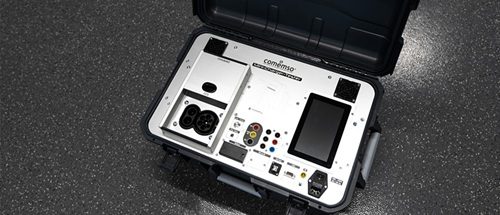
View original publicationDue to the constant expansion of the charging infrastructure, charging station manufacturers all over the world are faced with the task of carrying out proper commissioning and maintenance of existing charging stations. To make this easy, reproducible, fast and safe for service technicians, comemso has developed the well-known Mini-Charger-Tester. Our handy case has now been upgraded with some new features and is available for you in hardware generation 3.5.
In addition to the well-known and appreciated features for testing AC and DC charging stations, the new generation of the Mini-Charger-Tester will get even more with the next software release at the end of Q1/2023. There will be features like fault current injection for each individual phase and testing AC charging stations according to ISO 15118.
Furthermore, a charging station with two charging pistols will be able to be tested simultaneously using two Mini-Charger-Tester in a master/slave configuration simulating parallel charging. Stay tuned and order the Maintenance to get new functions like these.
Another advantage for you: If you order a new Mini-Charger-Tester Gen. 3.3 from now on, you will automatically receive the new Gen. 3.5. AC testing according to ISO 15118 will also be available as an update for version 3.3 via maintenance. If you want to learn more about the Mini Charger Tester, .